Last week I started the story of adjusting to a new world of eating and baking without soy, eggs, or dairy (also, shrimp, walnuts, dog, and peanuts, but really I don’t like nuts much myself in baking, and very little in my cookie-and-cake repertoire was ever prawn- or canine-based), now that my son’s allergies have been diagnosed.
About a week and a half into this adventure, I can say that it’s turning out stranger than I expected. The other day my wife was sitting on the couch asking me what I knew about “cheese rage”, supposedly a phenomenon where withdrawal from cheese and dairy manifests itself in your mood, and suspecting that she might be experiencing it. I don’t know about cheese rage, but I know that it can’t be easy for Gabriel to adjust to all the foods he’s suddenly had to leave behind. And it’s hard to know whether he understands what’s going on. His preschool teacher says that he’s been getting angry at the lunches I send with him lately, because they don’t have the foods he’s used to. A few days back he found (I don’t even know where) a stray pouch of Annie’s cheddar bunnies, which he barely liked before, and he clearly thought he had found the best thing in the world. Poor guy.
But we’re here to talk about baking. After the jump, you’ll find a very successful white bread recipe and a mostly successful toaster pastry recipe.
Bread, takes one and two.
Last time I made a version of Brother Fitzgerald’s Basic White Bread, and was waiting for it to cool enough to try. It turned out to be better than I expected for a first attempt. The texture was among the best I’ve gotten, but the crust ended up a little harder than I’d have liked. Last night it was time to bake up some more bread, so I made some modifications to the recipe. The results were delicious. The texture is just about perfect now, and the crust wasn’t too hard. We ate more than half the first loaf just with this morning’s breakfast, and I’ve since found that it is great for sandwiches also. Gabriel’s jelly toast consumption seems to have gone up, and for the first time my daughter actually eats bread that I baked (in fact she didn’t believe me when I told her it was my work). I see this one becoming a staple recipe for our family. Here’s the recipe, with a couple changes since last time.
White Bread for Gabriel
- 9 tsp active dry yeast
- 2 1/2 cups warm rice milk (I used vanilla rice milk because that’s what I had, and it worked out great)
- 2 Tbsp salt
- 4 Tbsp sugar
- 4 1/2 cups bread flour
- 3 – 3 1/2 cups pastry flour
- 2 Tbsp coconut oil
Warm the milk (not boiling, but noticeably above room temperature; last time it was lukewarm, warmer is better). Dissolve the yeast in 3/4 cups of milk and let stand for 10 minutes. Add half the flour and all the other dry ingredients, the coconut oil and the rest of the warm milk, and start to mix (I use a stand mixer). Add the rest of the flour in increments of 1/2 cup. I let the dough spend a total of about 13 minutes on a the stand mixer.
Let the dough rise in a covered, greased bowl for 45 minutes. Punch down and knead by hand for a minute or two. Let the dough rise in a covered, greased bowl for 45 minutes. Punch down and knead by hand for a minute or two, then divide the dough into two equal pieces and form the pieces into loaves. Put each loaf into its own greased bread pan (I spray olive oil for this), and let it rise for 45 minutes on top of the oven while it is preheating to 410º. Bake for 40 minutes. Do not overbake.
Remove promptly from pans and cool on racks.
You really should let it cool before slicing, but I can never resist more than a few minutes.
I’m fully satisfied with this as a white bread, so the next phase of my bread journey will be elsewhere. Perhaps something in the Italian herb direction.
Toaster Pastries … Tempting!
For these, I used this recipe from Smitten Kitchen, which I had previously made exactly as written (before the allergy situation arose).
Changes / Remarks:
- I used a combination of pastry flour and bread flour in a ratio of about 3:1
- vanilla Rice Dream instead of milk
- 1/4 C applesauce instead of the egg
- coconut oil instead of butter
- the filling was based on blueberry jam
- instead of an egg wash, I used rice milk mixed with corn statch as a “vanilla wash”. This was a good decision.
These were just plain delicious. The vanilla of the rice milk worked extremely well as a flavor complement to the blueberry filling, and the rice milk wash brought it out. Gabriel did eat some of these, though admittedly I ate most of them. Definitely going to make this again. And again and again. I want to try various other fruit fillings (cherry will probably be next) and also cinnamon-brown sugar. And by popular demand from my wife, I need to start icing them.
Next time I’m going to use banana-flax-and-water as an egg substitute instead of applesauce, and also a little more bread flour and a little less pastry flour. Not because the finished product wasn’t right with the recipe given — it was — but it was very hard to handle when preparing the pastries. It was too soft to be able to use the fold-over pastry gadget that I have.
Dire Cinnamon Rolls … questionable
Now, my son is a cinnamon roll monster, ever since my parents made some on Thanksgiving morning. The week after, he pulled me out of bed at about two in the morning, shouting “Cimmon rolls! Cimmon rolls, Daddy!” My wife found this recipe, and it seemed like just what the baker ordered, especially because the recipe claims to freeze well. And that chest freezer in my garage is just begging to be filled with a dozen rolls of cinnamon roll dough.
I made the recipe almost exactly as described on the website, with the following comments/clarifications.
- I doubled the recipe. I baked one batch and froze the other one (rolled up in a log and wrapped in foil) for later.
- I used coconut oil for the dough, but Earth Balance soy-free for the filling.
- I skipped the margarine altogether for the icing.
- I didn’t use maple syrup in the icing, but I did add maple extract. 1/2 tsp, perhaps?
The problem here was that the dough just didn’t rise properly, even though I waited almost twice as long as the recipe suggested. Not clear why that would be, especially since the yeast mixture seemed to be frothing enthusiastically at the start. The end results looked pretty weird, and nothing like the picture with the recipe. Not at all light or fluffy, just mostly-unrisen rolls of dough. The filling was terrific though, and the Earth Balance gave it a pleasant nuttiness. Icing was on the verge of overpowering, but lots of people like their cinnamon rolls that way. The dough tasted right, but the texture and look were very wrong.
I’ll be thawing out the freezer dough in a couple days, maybe we’ll be luckier next time. I’ll be trying alternative recipes all this week, because I really want to have cinnamon rolls for Christmas.
Bring on the cookies!
This weekend is blocked out for baking mass quantities of cookies. I’m starting with oatmeal raisin, and we’ll see where it goes from there. Report on that soon.



 Posted by Cap Khoury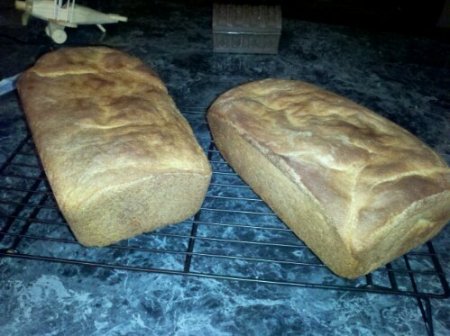
 Cap Khoury's Miscellanea
